
Key takeaways
- Network location alone should not determine whether a subject can access an enterprise resource.
- Authentication establishes identity but does not establish unrestricted authorization.
- A policy decision is effective only when the intended enforcement mechanism implements it.
- Zero Trust implementation requires ongoing validation of access paths, policy decisions and security telemetry.
Introduction
Consider an employee who connects to a corporate network using an authorized laptop and successfully completes multifactor authentication. The employee can access an internal application, but the network also permits connections to several unrelated systems.
Nothing necessarily appears wrong in the authentication logs. The employee is legitimate, the device is managed, and the connection originates from an approved network.
The problem is that access to the network has effectively become access to resources that were never explicitly authorized.
Now consider what happens if that employee’s device becomes compromised. An attacker may inherit network reachability that extends well beyond the employee’s legitimate business requirements.
Zero Trust Architecture changes the basis on which those access decisions are made. Rather than treating entry into a network as sufficient authorization, it evaluates access in relation to the requesting subject, the target resource and applicable security policies.
What Zero Trust actually means
Zero Trust is an architectural approach, not a product or a single network technology.
NIST SP 800-207 describes a resource-oriented security model in which location and ownership do not automatically confer trust.
An employee working from a corporate office should not receive unrestricted access merely because the connection originates from an internal subnet. Similarly, a remote employee should not automatically be considered unauthorized solely because the connection originates outside the corporate perimeter.
The important distinction is whether the access request satisfies the security requirements associated with the target resource.
| Traditional assumption | Zero Trust approach |
|---|---|
| Internal network location implies trust | Location is one contextual input |
| Network admission provides broad reachability | Access is restricted to authorized resources |
| Successful authentication is sufficient | Authentication and authorization are distinct |
| Security primarily depends on perimeter protection | Enforcement can occur at multiple resource boundaries |
Traditional firewalls and network segmentation remain useful. Zero Trust changes how these controls are designed, combined and evaluated rather than making them obsolete.
Core architectural components
The NIST logical model distinguishes three components with different responsibilities.
Policy engine
The policy engine evaluates access requirements and relevant context to determine whether access should be permitted, denied or revoked.
Policy administrator
The policy administrator translates the decision into instructions that establish, modify or terminate an authorized communication path.
Policy enforcement point
The policy enforcement point mediates the actual connection to the protected resource. Depending on the architecture, enforcement may occur through an application gateway, endpoint agent, workload proxy or other access-control mechanism.
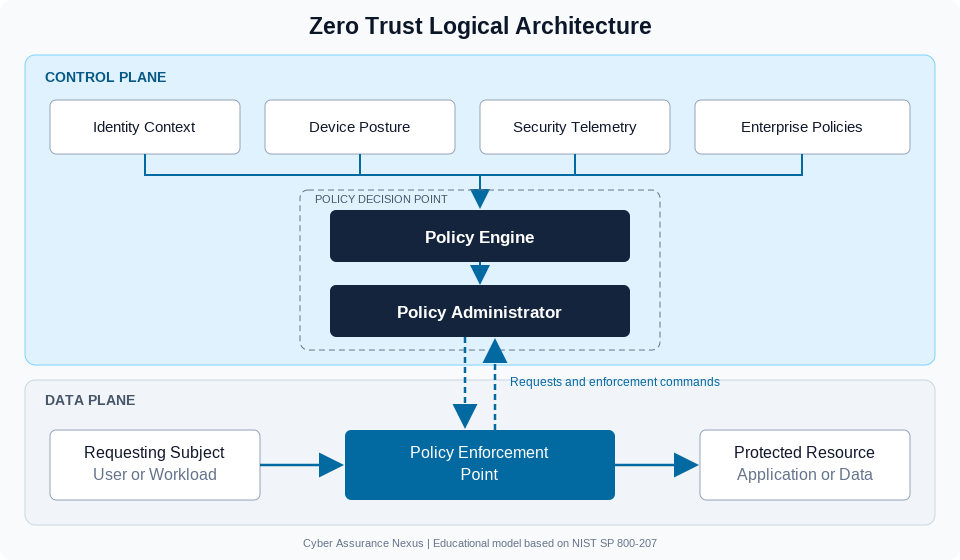
Figure 1. Simplified educational interpretation of the logical Zero Trust architecture described in NIST SP 800-207.
These are logical responsibilities. A technology platform may implement multiple responsibilities within the same service, or distribute them across several integrated systems.
The engineering challenge is to ensure that the decision made by the policy engine corresponds to the access that the enforcement mechanism actually permits.
Understanding access decisions
A useful starting point is to describe an access request using five questions:
- Who or what is requesting access?
- Which resource is being requested?
- What operation must be performed?
- Under what conditions should access be permitted?
- How will the authorization be enforced and verified?
For example, a database administrator may require access to a production database during an approved maintenance window.
A successful identity check establishes the administrator’s identity. It does not establish that the administrator should be allowed to connect from any device, use any protocol or access every database.
An illustrative authorization policy might require the following conditions:
| Policy attribute | Example requirement |
|---|---|
| Subject | Approved database administrator |
| Device | Managed and compliant workstation |
| Destination | Designated production database |
| Access path | Authorized administrative gateway |
| Operation | Approved maintenance activity |
| Duration | Limited maintenance window |
The network and application controls must collectively enforce these requirements. A firewall may restrict the access path, while database permissions govern the operations performed within that connection.
Neither control independently proves that the complete authorization requirement has been satisfied.
Implementing Zero Trust in an enterprise
Organizations should avoid beginning a Zero Trust program with the assumption that every existing security product must be replaced.
A practical starting point is to identify the resources that require protection and examine how those resources are currently accessed.
1. Discover resources and dependencies
An application inventory should identify not only application servers but also identity services, databases, administrative interfaces, service accounts and integrations.
Dependencies matter because a policy that protects the primary application may still leave a supporting service unnecessarily exposed.
2. Establish resource-specific access requirements
Business owners and security architects should identify which users, devices and workloads require access and what operations are necessary.
These requirements should be translated into explicit authorization policies. Unnecessary access should be removed after dependency and operational impact analysis.
3. Identify enforcement locations
Access requirements may need to be enforced at several layers.
A network firewall can restrict communication between security zones. An identity-aware proxy can control application entry. Application-level authorization can restrict individual business operations.
The architecture must specify which component is responsible for each requirement.
4. Define behavior during degraded conditions
A security architecture should describe how access behaves when a dependency becomes unavailable.
For instance, an identity service outage or unavailable device posture assessment creates uncertainty about whether new access requests satisfy policy.
The appropriate response depends on resource sensitivity, operational requirements and applicable safety constraints. High-risk access may need to be denied, while carefully controlled exceptions may be necessary for essential services.
These exceptions should be explicitly documented and tested rather than emerging accidentally during an outage.
5. Collect evidence and validate enforcement
Successful deployment is not demonstrated solely by the presence of a policy in a management console.
Engineers should correlate authorization decisions, enforcement logs, observed network paths and application outcomes to determine whether the intended controls are operating correctly.
Practical scenario: an internal reporting application
Consider a hypothetical enterprise with an internal reporting application hosted in a private cloud network.
Employees require read-only access to reports. Application administrators require management access. The reporting application also connects to a backend database.
A broad network policy that allows the employee subnet to reach the entire application environment may technically support business operations. However, it may also expose administrative interfaces and database services.
A resource-specific design separates these access requirements:
| Source | Destination | Intended access |
|---|---|---|
| Employee | Reporting application | Read authorized reports |
| Administrator | Management gateway | Approved administration |
| Management gateway | Application management interface | Restricted management |
| Application workload | Backend database | Required application operations |
| Employee | Backend database | Denied |
This design is illustrative. It does not represent an evaluated production environment.
The important question is whether every permitted connection corresponds to a legitimate business dependency and whether alternative paths can bypass the intended restrictions.
Common implementation failure scenarios
Network reachability exceeds authorization
A user may authenticate successfully to an application while retaining direct network access to its backend systems.
Validate both the authorized application path and attempts to reach protected dependencies directly.
Security context becomes outdated
A device may satisfy security posture requirements when access begins but become noncompliant later.
The architecture should define how posture changes are detected, how quickly they influence decisions and whether existing sessions can be restricted or revoked.
Policy decisions are not enforced consistently
Different access gateways or network enforcement points may apply different policy versions.
Configuration synchronization, policy version tracking and post-change validation can help detect inconsistent enforcement.
Operational recovery changes access paths
A failover or infrastructure recovery event may introduce an alternative route to a protected resource.
Recovery testing should therefore verify security enforcement as well as application availability.
Technical validation checklist
The following checklist is a proposed engineering aid, not a formal compliance assessment.
| Validation activity | Expected evidence |
|---|---|
| Authorized access test | Intended access succeeds |
| Unauthorized resource access test | Unapproved access is denied |
| Device posture change | Defined policy response occurs |
| Privilege removal | Access changes within the required interval |
| Enforcement dependency failure | Documented degraded behavior occurs |
| Infrastructure failover | Mandatory enforcement remains effective |
| Policy update | Intended configuration reaches relevant enforcement points |
| Audit evidence correlation | Decisions and observed access can be reconciled |
Each test should record its scope, initial conditions, expected outcome, observed outcome and supporting evidence.
A successful test establishes confidence only for the conditions that were evaluated. It does not establish that every possible access path or failure scenario has been covered.
Conclusion
Zero Trust architecture is most useful when it is treated as a set of enforceable security requirements rather than a collection of security products.
The essential engineering task is to connect resource-specific authorization requirements to the mechanisms that enforce them.
This requires understanding business dependencies, identifying enforcement boundaries, defining failure behavior and validating the access that actually occurs.
An organization should be able to explain not only why access was approved but also how that decision was enforced and what evidence demonstrates that the authorization remained effective.
Revision history
| Version | Description |
|---|---|
| 1.0 | Initial article draft |
References
Cite this article
Reference this article in your research, academic work or technical documentation.